The quest for innovation is not just a pursuit, but a necessity for manufacturers aiming to thrive.
At the Institute for the Study of Business Markets (ISBM), we are consistently exploring ways to guide businesses toward success in this dynamic environment. A recent groundbreaking study by Dr. Robert G. Cooper, titled “Winning the ‘Product Innovation Game’: The 2030 Mandate for Manufacturers,” offers invaluable insights into this journey.
Dr. Cooper, a renowned figure in the field of product innovation, lays out a compelling roadmap for manufacturers, highlighting the crucial role of innovative strategies in sustaining growth and competitiveness.
As we explore Dr. Cooper’s findings, we unravel the processes of successful product innovation and the transformative power of integrating modern technologies and methodologies. This article serves as a compass for manufacturers, guiding them through the essential elements that Dr. Cooper identifies as pivotal in winning the product innovation game by 2030.
Quick Takeaways
- AI enhances NPD by improving validation with digital twins, speeding up development, and fostering idea generation, proving essential for future success.
- The shift from traditional industries to sectors like IT in top US firms underscores product innovation’s vital role in business success.
- The rise of companies like Apple, contrasted with Kodak’s decline, shows product innovation’s necessity for corporate success.
- Early integration of Operations and AI in NPD is key for creating future-ready, market-relevant products.
The Changing Face of Top US Companies (1990 vs. 2020)
The landscape of America’s corporate giants has undergone a dramatic transformation over the last three decades, a change that speaks volumes about the shifting paradigms in business success.
In 1990, the top 10 US firms were deeply rooted in traditional physical product industries, with half of them leading in oil and gas or petrochemicals. Fast forward to 2020, and the picture is starkly different. Only two companies from the 1990 roster – IBM and GE – remain, albeit in lower positions.
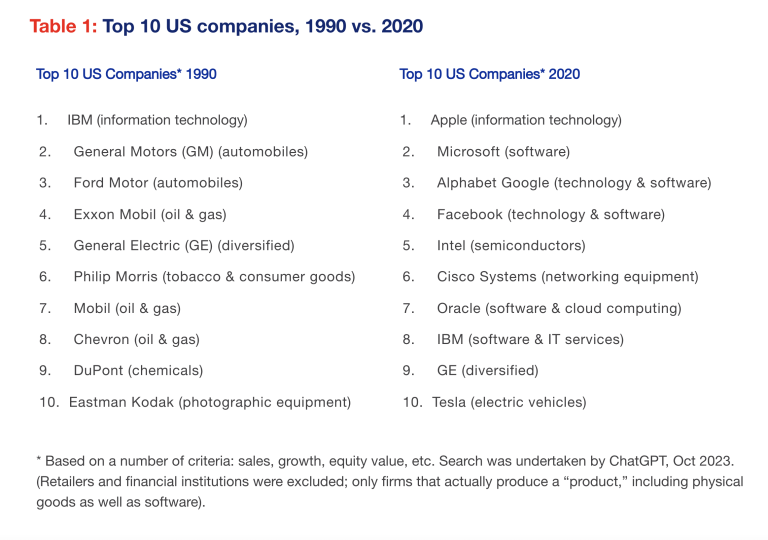
This shift illustrates a critical transition: A move from older technologies to innovative sectors like Information Technology and electric vehicles.
Today, manufacturers such as Apple, Microsoft, and Tesla dominate the list, propelled to the top by their unwavering commitment to product innovation. This evolution not only underscores the importance of adapting to changing market dynamics, but also highlights the pivotal role of innovation in staying relevant and leading in the competitive landscape.
The Importance of Product Innovation
Product innovation is not just a competitive edge; it is a survival imperative. As demonstrated by the remarkable transformation of the top US companies over the past three decades, innovation propels companies from mere existence to greatness.
Dr. Cooper’s analysis illustrates how firms like Apple and Microsoft have risen to the top, primarily through groundbreaking product innovation. Conversely, the decline of companies such as Kodak, which failed to adapt to digital technology, underlines the peril of stagnation.
This historical lens serves as a stark reminder for manufacturers: to prosper in the rapidly evolving landscape of 2030 and beyond, excelling in product innovation is not optional but essential.
New Product Development (NPD) Processes
For manufacturers aiming to excel in product innovation, the robustness of their New Product Development (NPD) processes is crucial.
Dr. Cooper emphasizes the integration of Operations staff early in the NPD process as a vital step. This approach ensures that practical aspects of manufacturing feasibility and cost considerations are ingrained from the outset, leading to more viable and market-ready products.
Additionally, embracing Industry 4.0 technologies, especially Artificial Intelligence, can revolutionize these processes. AI not only aids in streamlining the NPD process, but also plays a critical role in predicting and enhancing the success rates of new products.
In this light, NPD becomes not just a process of creation but a strategic tool, finely tuned with technological advancements and operational insights, to deliver products that resonate with future market demands.
Challenges in New Product Commercialization
Dr. Cooper highlights that the journey from conception to successful commercialization of new products is fraught with challenges for manufacturers.
One stark reality he points out is the low success rate of new-product projects, with only 25-30% succeeding commercially. This underwhelming success rate is often a result of cumbersome and inefficient NPD processes, plagued by bureaucracy and non-value-added work.

Dr. Cooper stresses the importance of streamlining these processes, making them more agile and responsive to market needs, to improve the chances of commercial success.
The Role of Operations in NPD
The involvement of Operations in the NPD process can be a game-changer for manufacturers. Dr. Cooper suggests four ways in which Operations can make a significant impact.
By integrating these strategies, Operations can significantly enhance the pace of innovation and increase the chances of new product success.
1. Play New-Product Football
Dr. Cooper advocates for a cross-functional team approach to NPD, where Operations are involved from the beginning. This approach is likened to a football team’s collaborative effort, ensuring all departments, including Operations, contribute throughout the process.
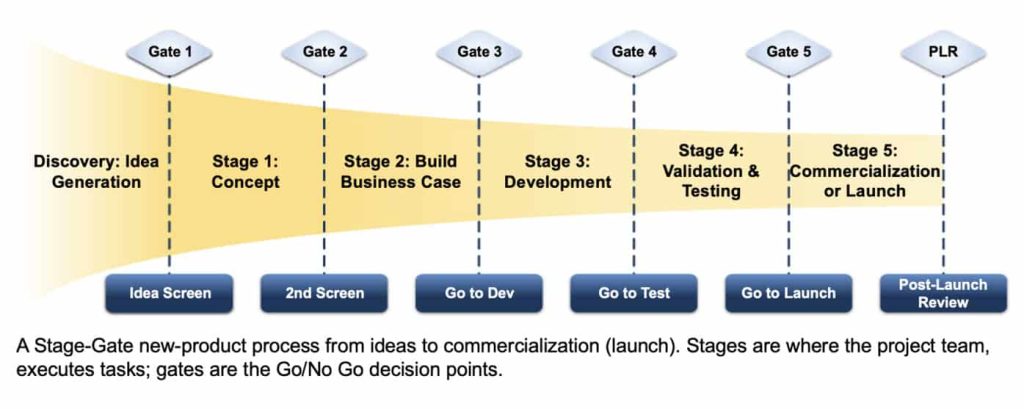
This strategy overcomes the disjointed, relay-race style approach that leads to many ‘dropped batons.’
2. Making Right Go/Kill Decisions
Operations’ involvement is crucial in making informed Go/Kill decisions at various stages of NPD. Their insights into manufacturing feasibility, costs, and potential risks play a pivotal role in selecting projects with the best commercial prospects.
3. Accelerate the Game, Remove the Waste
Dr. Cooper highlights the application of Lean principles to the NPD process. He points out that Operations, familiar with Lean methodologies, can lead the way in identifying and eliminating bottlenecks and inefficiencies, thereby accelerating the development process.
4. Be Agile in NPD
Emphasizing agility, Dr. Cooper suggests adopting flexible development practices that allow for quick pivots in response to changing market needs or unexpected challenges. This approach, borrowed from Agile software development, involves continuous build-and-test iterations to ensure the product evolves in line with customer feedback and technical requirements.
Integrating AI into the NPD System
In his study, Dr. Cooper emphasizes the transformative potential of integrating Artificial Intelligence (AI) into the New Product Development (NPD) system. He notes that while AI has significantly impacted manufacturing, its penetration into NPD has been slower. Cooper advocates for early adoption of AI in various stages of the NPD process:
- AI in the Validation Stage: Digital twins, as an AI application, can replicate the product to monitor real prototype performance during trials, thus enhancing the quality of test data and expediting the validation process. This approach allows for more accurate and efficient field trials, providing invaluable insights into product performance and user experience.
- AI in Development: AI can significantly reduce development times by digitally simulating and optimizing product components, as evidenced in industries like turbine design. This method not only accelerates the development cycle but also enhances the precision and effectiveness of the product design.
- AI in Idea Generation: AI tools can scan vast information sources to identify unmet market needs and opportunities, sparking innovative product ideas. Beyond mere identification, AI can also assist in conceptualizing new products, creating initial designs and concept drawings, thereby streamlining the early stages of NPD.
Moreover, AI can facilitate better portfolio and project management, potentially making crucial Go/No Go decisions through predictive analytics. Dr. Cooper’s insights underscore the necessity for Operations to spearhead the integration of AI in NPD, leveraging their familiarity with AI applications in manufacturing.
Embrace Product Innovation for Future Success with ISBM
Dr. Robert G. Cooper’s insights into the ‘Product Innovation Game’ present a compelling mandate for manufacturers. As we approach 2030, embracing robust NPD processes, integrating Operations early, and leveraging AI and Industry 4.0 technologies become not just strategies, but necessities for survival and growth in the manufacturing sector.
Join us and register for ISBM’s OPEN workshop this February to explore the key concepts of Dr. Robert G. Cooper’s groundbreaking report on product innovation. Don’t miss this opportunity to gain expert insights and practical strategies for succeeding in the 2030 manufacturing landscape.
ISBM is a nonprofit, global network of business researchers and practitioners. Ask about how an ISBM Membership can help you now or visit ISBM today to learn more!