AI innovations in B2B marketing are reshaping the present landscape. Artificial intelligence (AI) is a game-changer, revolutionizing how businesses interact with customers and understand their needs.
Drawing insights from leading experts like Christopher Penn and the team of Kristyn Corrigan, ISBM Fellow Gerry Katz, & Artem Timoshenko, we explore this new era where AI is the driving force behind innovative marketing strategies. This article explores how AI is transforming B2B marketing, making it more efficient, personalized, and insightful than ever before.
Quick Takeaways
- AI integration in B2B marketing is a fundamental shift, with 57% of U.S. B2B marketers adopting chatbots for audience understanding.
- AI innovations enhance customer interactions by providing data-driven insights and predictive analytics.
- AI-driven content personalization is projected to reach a $72.1 billion market size by 2030, driving customer engagement and conversions.
- AI transforms CRM with predictive analytics, chatbots, enhanced sales forecasting, and automated data analysis, improving customer experiences while necessitating ethical considerations.
The Evolving Role of AI Innovations in B2B Marketing
The integration of AI into B2B marketing is not just a trend; it’s a fundamental shift.
A recent statistic underscores this evolution: 57% of B2B marketers in the U.S. have adopted chatbots in their demand generation programs to better understand their audience. This highlights the growing reliance on AI tools for deeper audience engagement and improved marketing efficiency.
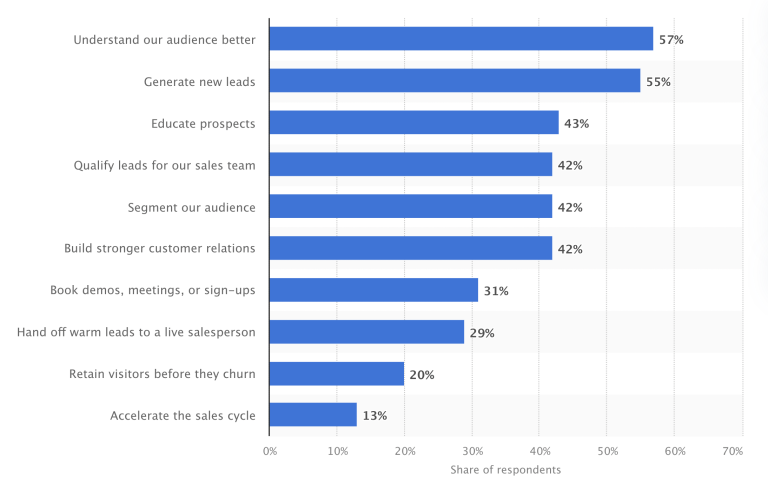
AI innovations in B2B are leading to more sophisticated customer interactions. Marketing strategies, once heavily reliant on human intuition and guesswork, are now being enhanced by data-driven insights and predictive analytics. AI’s ability to analyze vast amounts of data in real time is enabling B2B marketers to understand customer needs more accurately and tailor their strategies accordingly.
Moreover, the insights at a recent ISBM Member Meeting from Christopher Penn and Corrigan, Katz, & Timoshenko show that this shift is not just about automation but about creating more relevant, personalized, and efficient marketing approaches:
- Penn’s concept of the ‘Marketing Singularity‘ emphasizes how large language models are redefining content creation and customer interaction in marketing.
- Corrigan, Katz, & Timoshenko’s work on Voice of the Customer (VOC) analytics illustrates how AI is central to capturing and analyzing customer feedback in the B2B sphere.
The future of B2B marketing lies in embracing these AI innovations, leveraging them to build more dynamic, responsive, and effective marketing strategies. As AI continues to evolve, it will undoubtedly unlock new potentials and pathways for B2B marketers, fostering a more connected, insightful, and agile marketing environment.
AI-Driven Content and Personalization
AI innovations are revolutionizing the way content is created and personalized in B2B marketing. A striking indicator of this trend is the projection that the global market size for AI in marketing will reach approximately $72.1 billion by 2030. This growth reflects the increasing adoption of AI for more dynamic and tailored content strategies.
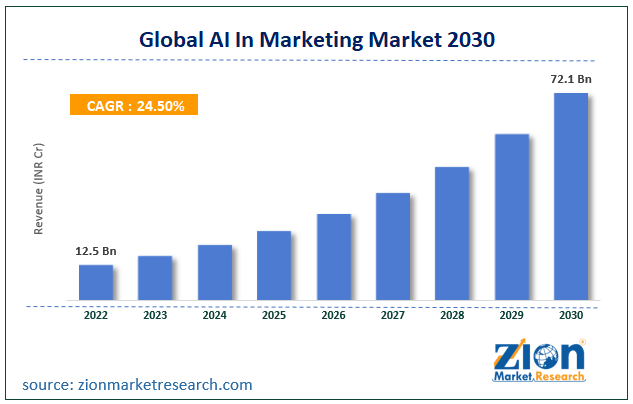
Content personalization, powered by AI, allows marketers to create highly relevant and engaging experiences for each customer. AI algorithms analyze customer data, enabling marketers to craft content that resonates with individual preferences and behaviors. This approach not only enhances customer experience but also drives better engagement and conversion rates.
Furthermore, Christopher Penn’s insights on large language models indicate a shift towards more automated yet sophisticated content creation processes. AI tools are now capable of generating content that closely aligns with specific marketing goals and audience interests. This capability is integral for B2B marketers to maintain a consistent and relevant voice across various channels.
In conclusion, the integration of AI in content creation and personalization is a significant stride in B2B marketing, offering unprecedented levels of efficiency and customer engagement. As AI technology continues to advance, its role in shaping effective and personalized marketing strategies is set to grow even more prominent.
AI and Customer Relationship Management (CRM)
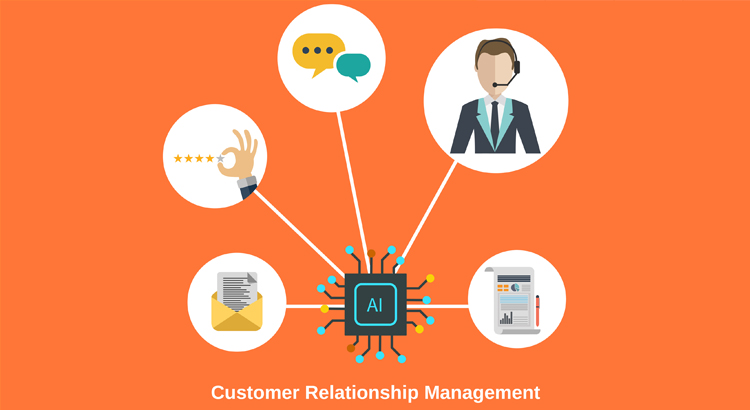
AI has revolutionized predictive analytics in CRM. It analyzes customer behavior patterns to anticipate future needs and preferences. This insight helps businesses tailor their marketing efforts and product offerings, resulting in more effective customer engagement and increased sales opportunities.
AI in Customer Service
AI-powered chatbots and virtual assistants in CRM systems have transformed customer service. These tools provide quick, efficient responses to customer inquiries, available 24/7, enhancing customer satisfaction and freeing up human agents for more complex tasks.
AI for Enhanced Sales Forecasting
AI in CRM contributes to precise sales forecasting. By analyzing past sales data and market trends, AI provides valuable insights for future sales strategies. This helps businesses allocate resources effectively and plan strategically.
Automated Data Entry and Analysis
AI in CRM contributes to precise sales forecasting. By analyzing past sales data and market trends, AI provides valuable insights for future sales strategies. This helps businesses allocate resources effectively and plan strategically.
Impact on Customer Experience
The integration of AI in CRM has a profound impact on customer experience. It enables personalized interactions based on customer data, ensuring each customer feels understood and valued. This personalization fosters loyalty and enhances overall customer satisfaction.
Balancing AI and Ethical Considerations
In the rapidly advancing field of AI, ethical considerations have become increasingly prominent. Ethical challenges in AI encompass a wide range of issues, including data privacy and security, bias and fairness, accountability and responsibility, job displacement, and the economic impact of AI advancements.
- Data Privacy and Security: AI must prioritize user data security and ethical data management practices, ensuring transparent and responsible handling of sensitive information.
- Bias and Fairness: AI algorithms should be scrutinized to eliminate bias, promoting fairness and preventing discrimination against any group.
- Accountability and Responsibility: AI system ownership must be clear, with ethical guidelines governing use, ensuring developers and users are accountable for their deployment.
- Job Displacement and Economic Impact: AI’s role in the workforce requires balancing automation benefits with reskilling initiatives for affected employees.
- Autonomous Systems and Accountability: As AI systems become more autonomous, maintaining human oversight and responsibility is crucial for ethical implementation and risk management.
Addressing these ethical concerns is not just a necessity but a moral obligation in the field of AI. Establishing ethical AI practices, including data privacy, reducing bias, and promoting transparency, is essential for building reliable and equitable AI systems.
Embracing the Future: The Impact of AI Innovations in B2B Marketing
The advancement of AI innovation in B2B marketing is reshaping the landscape, bringing about more effective, personalized strategies and transforming CRM systems.
As AI evolves, it is essential to balance technological advancements with ethical considerations to ensure responsible development. This ongoing integration of AI in B2B marketing not only enhances current capabilities, but also sets the stage for future growth and innovation in the field.
ISBM is a nonprofit, global network of business researchers and practitioners. Ask about how an ISBM Membership can help you now or visit ISBM today to learn more!